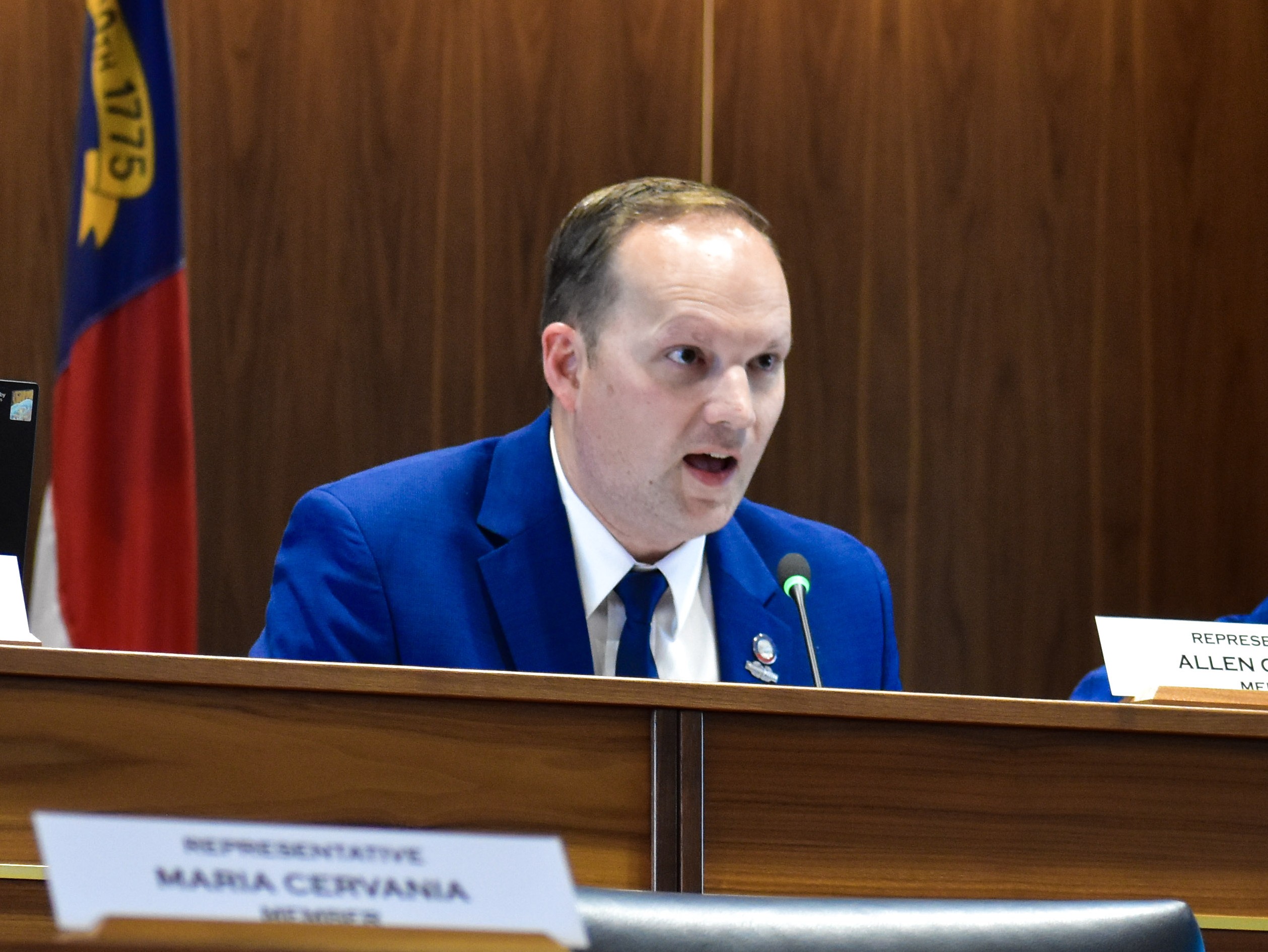
In a daylong hearing June 4 that provoked sadness and anger, House Oversight Committee members grilled Charlotte, Mecklenburg County, and state officials over the death of Dominique Moody—a six-year-old girl who had been tortured, abused, and kept in a dog cage until she died weighing just 27 pounds.
By the end of the day, Rep. Allen Chesser (R-Nash), who chaired the session, called for Mecklenburg County District Attorney to consider criminal charges against county employees for failing to intervene.
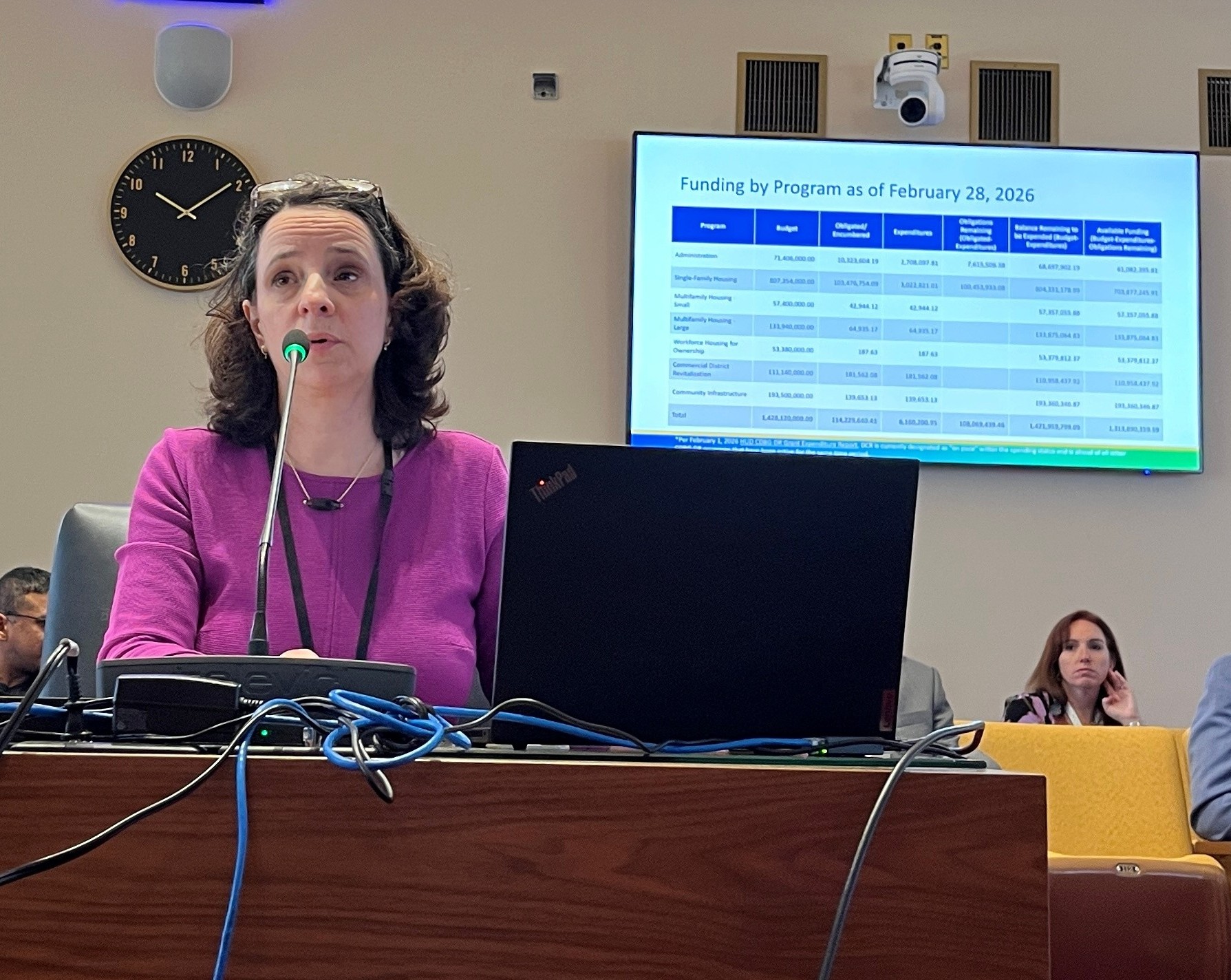
Members first questioned state Department of Human Services officials on their investigation of Mecklenburg County’s child protective services and discussed the potential value of predictive risk models with UNC School of Social Work professor Emily Putnam-Hornstein. Members then asked Charlotte Mecklenburg Police Chief Estella Patterson and Mecklenburg County Sheriff Garry McFadden about multiple law enforcement visits to the home over years.
County Manager Michael Bryant, Interim DSS Director Letecia Loadholt, and Deputy County Manager Kimm Campbell faced more than four hours of questions in the afternoon.
“Mecklenburg County received multiple reports of abuse and neglect and conducted assessments yet failed to intervene further,” NC Department of Health and Human Services Division Director for Human Services Lisa Tucker Cauley told the committee. She described multiple other failures across 122 additional cases NC DHHS examined.
Putnam-Hornstein said evaluations of predictive risk models had found they reduced both racial disparities and child fatalities. She was confident that “a model would have flagged her [Dominique’s] case for closer scrutiny.”
Putnam-Hornstein questioned Mecklenburg’s prioritizing new positions instead of better training and technology: “It’s not at all clear to me based on the facts that have been released that hiring 21 additional people in Mecklenburg County would have made any difference in Dominique’s case or is the kind of systemic change that is needed.”
In an early indication of his frustration with the county, Rep. Chesser asked Cauley, “What may exist in a home that would make it unsafe for a worker to go there but make it safe for a child to remain in that home?”
Members’ incredulity climbed with law enforcement’s testimony. Rep. Mike Schietzelt (R-Wake) wondered how clearly visible holes in floors and walls leading to the outside did not raise more concern: “There were flashing red signs that should have tipped people off that something was not right here.”
Rep. Carla Cunningham (D-Mecklenburg) emphasized that CMPD is not solely responsible but, “A lot of people closed their eyes and failed to see.”
Rep. Heather Rhyne (R-Lincoln) asked Bryant and Loadholt concentrated on the county’s tendency to downplay its problems. A Program Review found it performed “only slightly worse than other large metropolitan areas” on recurrence of maltreatment and other indicators.
“And I submit to you that, tragically,
Rep. Harry Warren
Dominique Moody was not served.”
Co-Chair Harry Warren (R-Rowan) told Bryant in relation to his role as county manager, “As you once said, and you’ll recall, I’m sure, we exist for one reason and for one reason only, to serve. And I submit to you that, tragically, Dominique Moody was not served. It wasn’t a lack of funding that led to her death, but it was poor performance, lack of supervision, and lack of a culture that was there to serve.”
Rep. Brian Echevarria (R-Cabarrus) read directly from an officer’s graphic account of the condition of the home and of the child. “It was extremely unkempt with strong odor of feces and urine. The residence was cluttered and numerous rats were scurrying through it. The residence had a mixture of animal and human feces throughout. … She had open wounds and scarring in various stages of healing covering most of her body.”
After calling for the district attorney’s to explore criminal charges, Rep. Chesser closed stating, “I hope that the plan you have in place, Mr. Bryant, with the trust that you’ve placed in these two ladies is well rewarded, but if it comes without consequences for those who cause the reason that you’re sitting here, it’s forfeit. It’s empty, it’s hollow, and it’s worth nothing.”
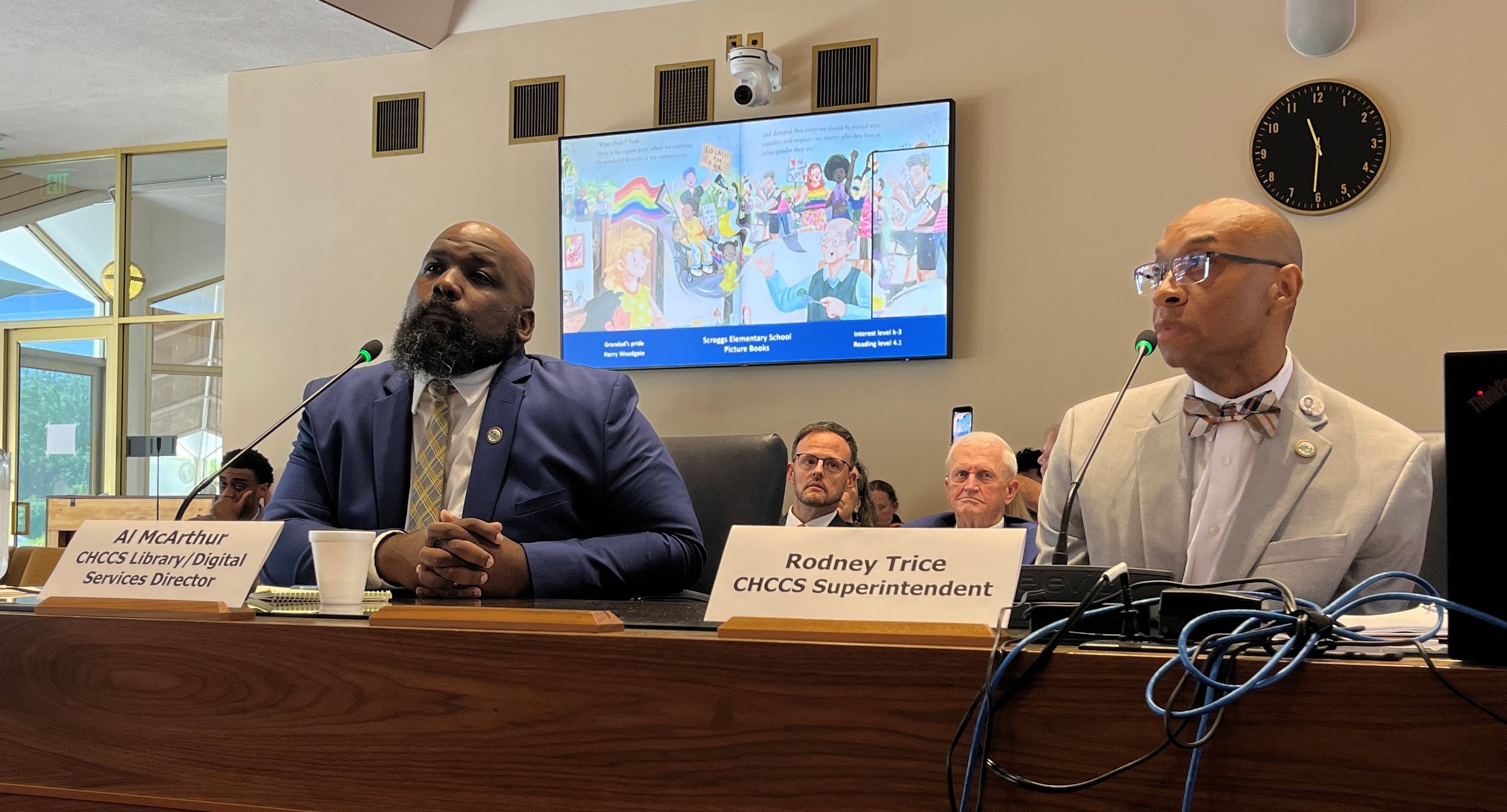
Chapel Hill-Carrboro City Schools Superintendent Rodney Trice on April 23 became the first local government official to appear twice before House oversight committees. Committee members called him back out of frustration over the school district’s continued disregard of legislative intent behind the Parents’ Bill of Rights (SB49) passed in 2023.
Trice first appeared before the committee in December with former Board Chair George Griffin after videos surfaced of Griffin stating that the school board had refused to comply with the law. Trice and Griffin both testified under oath that the district had always been in compliance with the law as they sparred with members over the difference between board policy and administrative guidance, what materials are subject to the law, and the district’s responsibility for monitoring outside resources linked from its websites.
This time, Director of Digital Learning and Libraries Al McArthur joined Trice as a witness to discuss library holdings.
From the start, Chairman Brenden Jones (R-Columbus) demonstrated that teachers and school leadership as recently as February 2026 were unsure how to handle name and pronoun change requests.
Rep. Grant Campbell (R-Cabarrus) asked why the district still had guidance in 2026, after the last hearing, for school officials to find “a developmentally-appropriate manner to determine the best path forward for the school to affirm the student’s identity” if parents objected to gender and pronoun changes.
Campbell was the first of many committee members to ask Trice and McArthur whether sexually explicit books were appropriate in grade school libraries and what role libraries and library books have in support of the curriculum. It took nearly two hours before McArthur told Rep. Harry Warren (R-Rowan) “No,” it would not be appropriate to have those books in the library. Next, Trice acknowledged to Rep. Mike Schietzelt (R-Wake) that every book in the library is tied to the curriculum in that they are there to encourage literacy and reading. “So, if we’re serving students’ literacy by serving student interests then aren’t we supplementing the curriculum with these books? And wouldn’t that fit squarely within the definition that we have right here in the statute that has been read over and over and over in today’s hearing?” Claiming otherwise, Schietzelt said, was just “silly.”
Subverting the law
Rep. Jake Johnson (R-Polk) and Rep. Allen Chesser (R-Nash) both commented on what Johnson called the district’s, “willful effort to subvert the intent of Senate Bill 49.”
Chesser added, “I think what we are witnessing is an administration that is hellbent on circumventing the law in any way they can.”
Trice claimed that the district’s website is not covered under SB49. He told Rep. Brian Echevarria (R-Cabarrus) that a committee reviews changes to the website but that a rogue employee hid, but did not delete, CHCCS-created LGBTQIA+ resource pages after the district received the first letter from the Committee in November. (Those pages still exist but the links are still not on the equity page.)
To illustrate the types of books with explicit material that CHCCS schools have chosen to be on their shelves, Jones displayed a photo of a page from “Grandad’s Pride” by Harry Woodgate and read a passage from “It Feels Good to Be Yourself: A Book About Gender Identity” by Theresa Thorn and “My Maddy” by Gayle E. Pitman.
Jones closed by announcing that he had filed HB1043—the CHCCS Act (for Curriculum, Honesty, Compliance, and Child Safety) which would close some of the loopholes identified in the hearing, clarify legislative intent, and cut central office funding for willfully noncompliant school districts.
Watch the hearing on YouTube here.
View the transcript here.
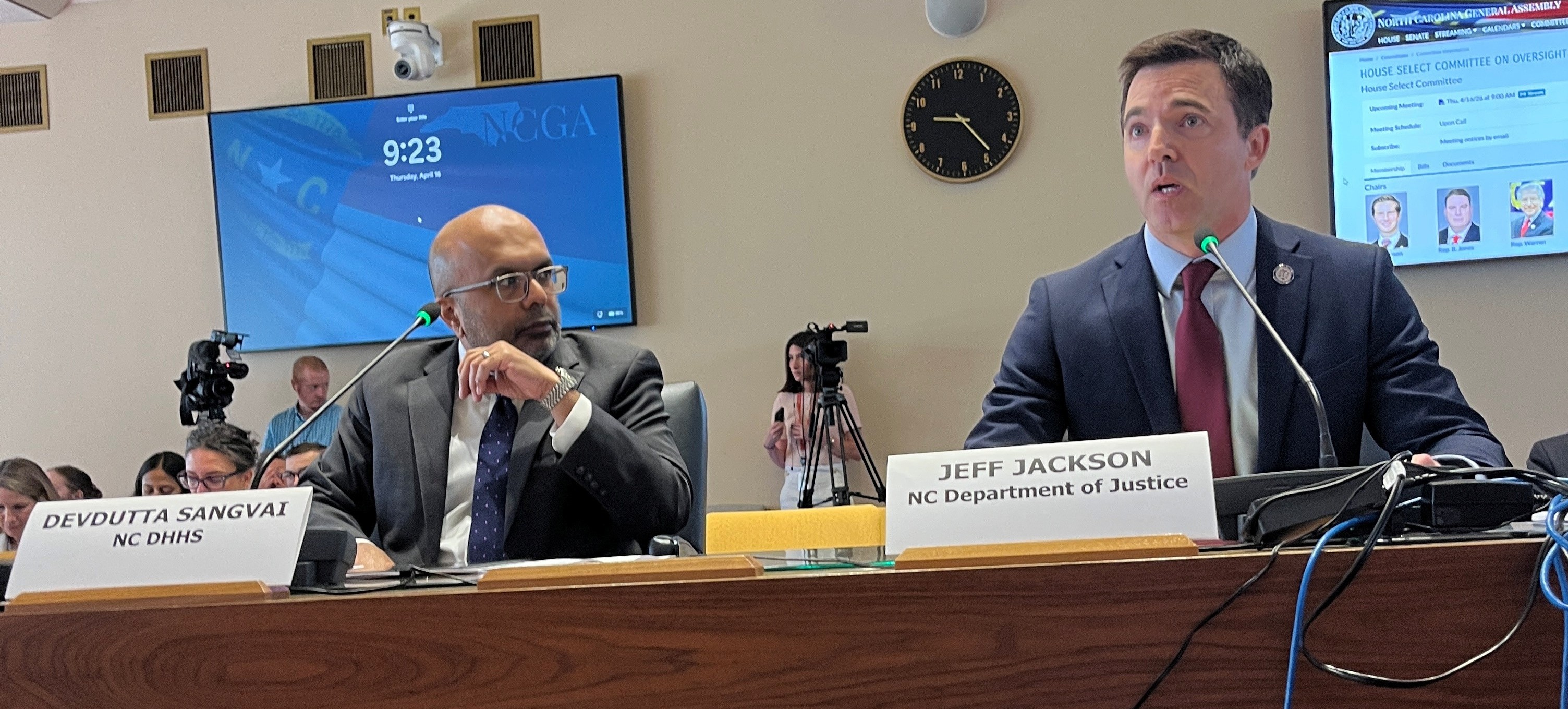
Chairman Grant Campbell (R-Cabarrus) opened the April 9 hearing of the House Select Committee on Oversight and Reform with a reminder of the program’s scale: it cost $36 billion in fiscal year 2025—more than the state’s General Fund— including $6 billion in state tax dollars. Medicaid enrollment grew by 984,000 people between 2019 and 2025, compared to total population growth of 710,000, and to cover 26 percent of the population.
Over the course of three hours, committee members asked Department of Health and Human Services Secretary Devdutta Sangvai and Attorney General Jeff Jackson what more their offices can do to detect, punish, and prevent waste, fraud, and abuse.
They asked about beneficiary and provider enrollment. Chairman Campbell highlighted one agency whose address is a building with boarded up windows according to Google. “Can we at least all agree that there’s much more that we can do to ensure this money is being used appropriately?” Campbell asked. Jackson and Sangvai said that North Carolina is actually ahead of other states in using data analytics to detect suspicious providers and charges.
Rep. Allen Chesser (R-Nash) asked why Medicaid referred just 114 of 1,867 complaints from insurers about providers to the DOJ’s Medical Investigations Division (MID). Rep. Mike Schietzelt (R-Wake) asked why North Carolina ranks 37th in the nation in criminal convictions for Medicaid fraud.
Jackson said the DOJ does not have authority to prosecute cases on its own and must hand them either to the appropriate local district attorneys or U.S. Attorney, noting that federal law provides stiffer criminal penalties for fraud than state law. Jackson added that the state can recover treble damages in civil cases but can only recoup payments in criminal cases.
Skyrocketing autism cases, partly driven by a change in what results in a diagnosis, led the General Assembly to increase reimbursement rates by 15 percent in 2023. These changes have brought flood of providers into the system. While necessary, all agreed, the changes increased the potential for fraud. Sangvai acknowledged that DHHS needed to tighten clinical policy as a way to reduce that potential.
Campbell emphasized that there are real consequences for the most vulnerable: “Every dollar of waste, fraud, or abuse that is unrecognized, unenforced, ignored is a dollar that’s not available for North Carolinians that need care.”
The hearing provided direction for Medicaid rebase bill HB696 and pointed to additional possible reforms in statute, policy, and practice.
Watch the hearing on YouTube.
View the transcript here.
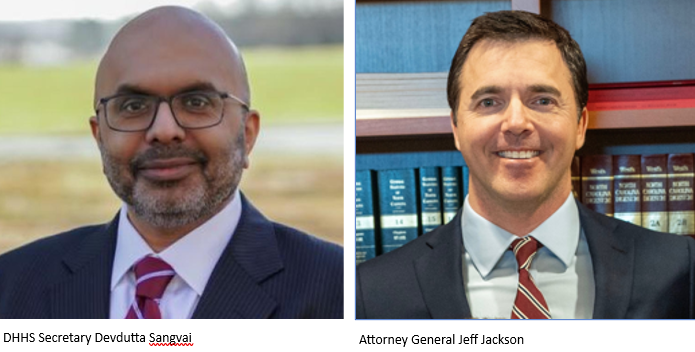
The House Select Committee on Oversight and Reform has called Department of Health and Human Services Secretary Devdutta Sangvai and Attorney General Jeff Jackson to testify Thursday, April 16 at 9 a.m.
Medicaid spending in North Carolina is $36 billion, and enrollment is growing faster than the state’s population. Spending on Applied Behavior Analysis therapy has skyrocketed. Members have concerns about how waste, fraud and abuse are monitored. This also leads to questions about the $1.1 billion rebase request from Governor Josh Stein.
“The soaring costs for Medicaid are unsustainable for our taxpayers,” Chair Grant Campbell (R-Cabarrus) said. “It leads us to question how those in charge are doing their jobs. And if they’re not policing waste, fraud, and abuse, how realistic is the governor’s $1.1 billion funding request?”
State officials touted progress on Hurricane Helene recovery at an April 2 legislative hearing — and at least one lawmaker wasn’t having it.
Testifying before the Joint Legislative Commission on Governmental Operations’ Hurricane Response and Recovery Subcommittee, Department of Commerce Deputy Secretary Stephanie McGarrah and GROW NC Director Matt Calabria updated members on the Renew NC homeowner repair program, state funding, and private road and bridge work.
Calabria and McGarrah highlighted that Renew NC has completed repairs on 30 homes — faster, they said, than any other state after any other storm. Rep. Karl Gillespie (R-Macon) called that claim an “insult” to the 3,704 homeowners still waiting.
“We need to be focusing on helping them, not on some small successes that we’ve had,” he said.
The math doesn’t work
As of April 2, the program has 3,597 active applications and $807 million in federal Community Development Block Grant-Disaster Recovery funding. McGarrah said the money would not cover everybody currently in the program at the current rate of $276,285 per home.
“The numbers don’t add up, and meanwhile, the citizens of North Carolina are suffering.”
Rep. Karl Gillespie
On the other hand, she also told members the program could build 800 homes per year and finish in three years, which would complete roughly 2,400 homes by the end of 2028. But mountain building seasons can run as short as six months, meaning contractors would need to complete 133 homes per month to hit that target. If it were able to complete all those homes for an average of $277,000, the program would finish under budget.
Gillespie wasn’t convinced of either the projected shortfall or the projected speed of completion. He flatly told McGarrah, “The numbers don’t add up, and meanwhile, the citizens of North Carolina are suffering.”
Relocation money, disputed priorities
McGarrah said severely limited rental availability will make the program difficult to use. She and Calabria proposed spending $60 million of $120 million, already appropriated by the General Assembly but unused, to pay temporary relocation assistance (TRA). McGarrah said the other $60 million funds could go toward affordable housing if not being poured back into the main single-family home program.
Rep. Mark Pless (R-Haywood) pushed back on the new construction idea: “What I care about is what got destroyed, and people are counting on us to build back because I gave them my word.”
McGarrah acknowledged the statutory language is vague on the ability to redirect the unspent $120 million and legislative action would likely be necessary to spend any of it.
Roads, bridges, and a $1 million question
Calabria reported that 74 private road and bridge projects have been completed, restoring access for 421 households, with 173 more underway.
Gillespie flagged high costs and long delays stemming from the way bridges have been planned, designed, and built: “We’ve had numerous conversations about private roads and bridges, and a $100,000 bridge costing $1 million — there’s room for improvement there.”
He closed the hearing with a promise of continued oversight.
Video here.
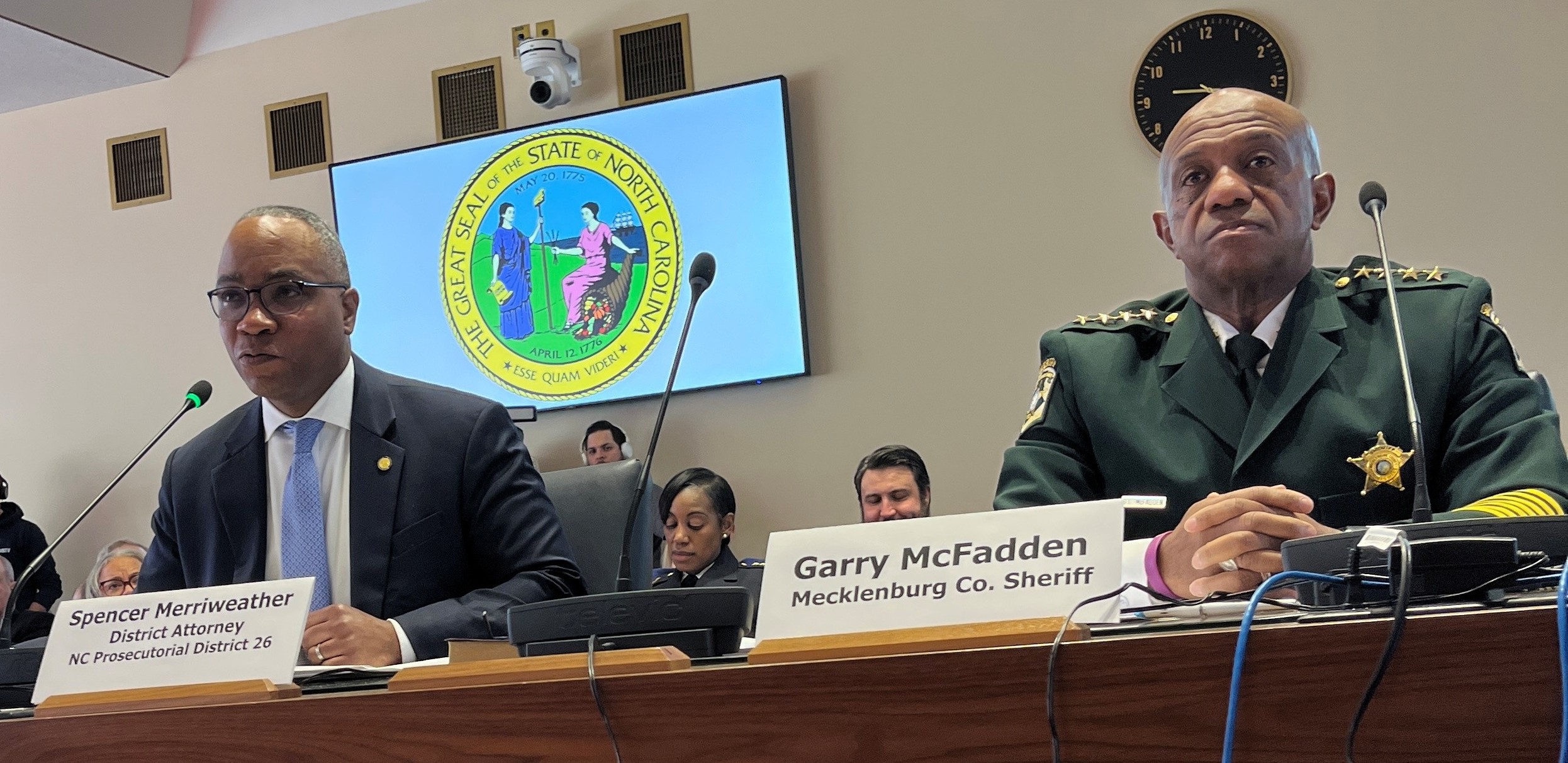
Mecklenburg County Sheriff Garry McFadden and other officials from Mecklenburg County and the City of Charlotte testified before the House Select Committee on Oversight and Reform on February 9. The planned topic was public safety, with concerns about immigration enforcement, mental health, public transit, and funding priorities
McFadden called himself the “elephant in the room” and lived up to that with long answers that bordered on lecturing committee members. The morning session with him and District Attorney Spencer Merriweather ran more than three hours, with most of that time dedicated to combative exchanges with the sheriff.
In contrast, the afternoon session with Charlotte-Mecklenburg Police Department Chief Estella Patterson, Mayor Vi Lyles, and City Manager Marcus Jones lasted just 80 combat-free minutes.
McFadden often said he could not answer questions due to ongoing litigation and an SBI investigation. Frustrated, Chairman Brenden Jones (R-Columbus) called a recess for McFadden to confer with his attorneys about what he could say.
Other than an impromptu civics lesson from Rep. Allen Chesser (R-Nash) that has gained national attention, members asked about safety in the county jail, work culture in the sheriff’s office, and detaining inmates for Immigration and Customs Enforcement (ICE).
McFadden said he still thinks Iryna’s Law is “a mistake” and that it has done “no good,” told the committee he was speaking specifically about Mecklenburg County. DA Merriweather called the legislation a “good thing.”
Asked why ICE picked up just 16% of Mecklenburg County inmates with a detainer in 2025 but picked up 65% of Wake County inmates, McFadden instead complained that state legislators did not seek his expertise before writing or passing the relevant laws.
Co-Chair Jake Johnson (R-Polk) explained to McFadden that being the only sheriff called to testify to the Committee “is not a point of pride.” Johnson added, “There are clearly problems within the department that we’re going to have to address going forward.”
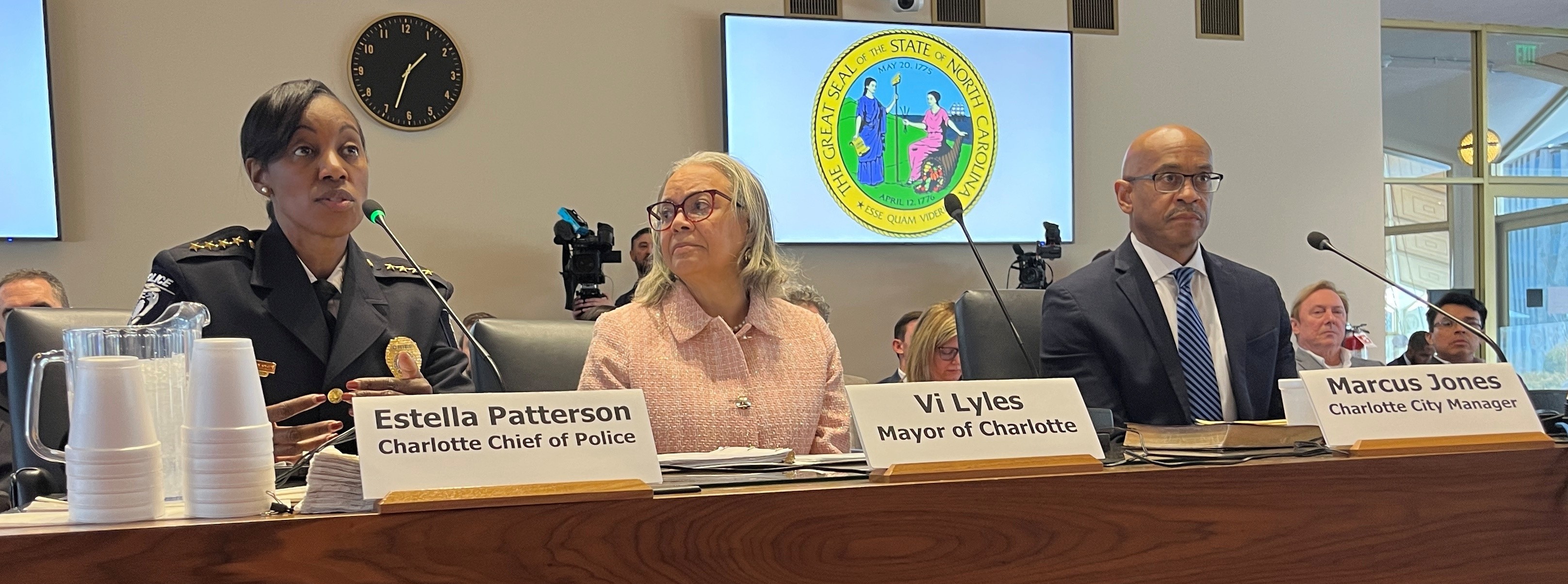
CMPD Chief Patterson described her plan to improve policing in Charlotte, including youth and mental health efforts. Rep. Brian Echevarria (R-Cabarrus) asked how the city could spend $100 million on diversity but not direct any of that to safety when 60% of violent crime victims are black.
Jones told Charlotte officials he wanted them to make national headlines for positive things, not for the not the things that have dominated the news cycle in recent months.
“I want Charlotte making national news for the World Military Games [next summer],” Rep. Jones concluded. “I want that city to be the shining gem of North Carolina that I know it can be.”
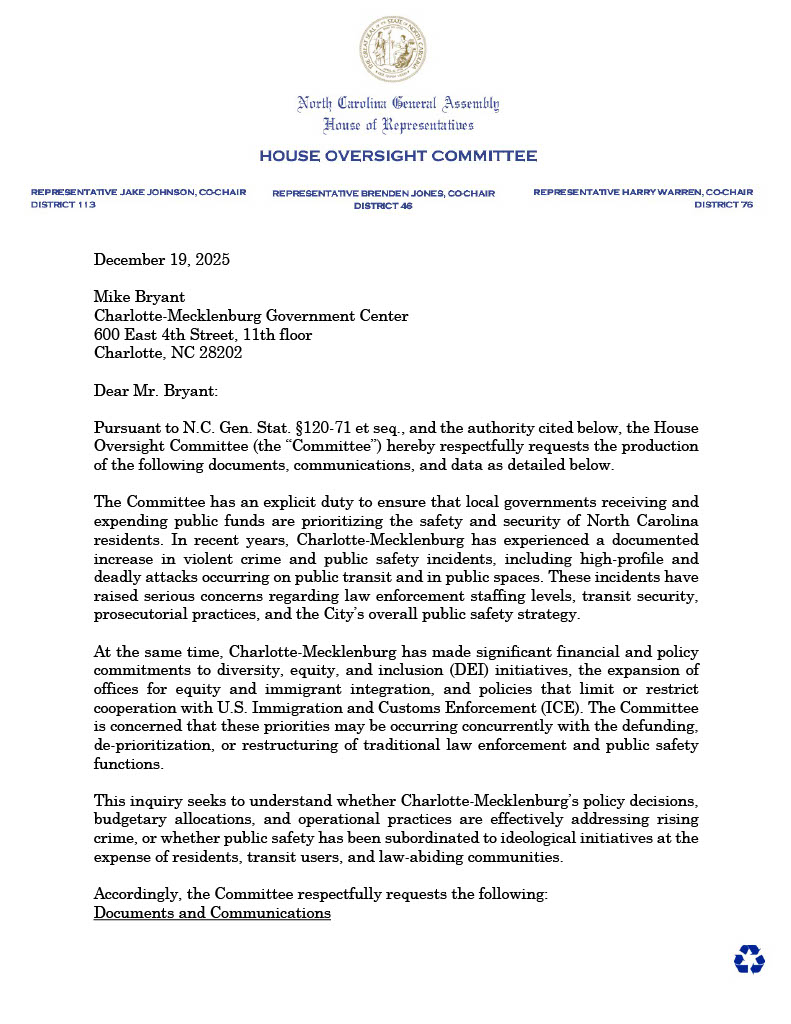
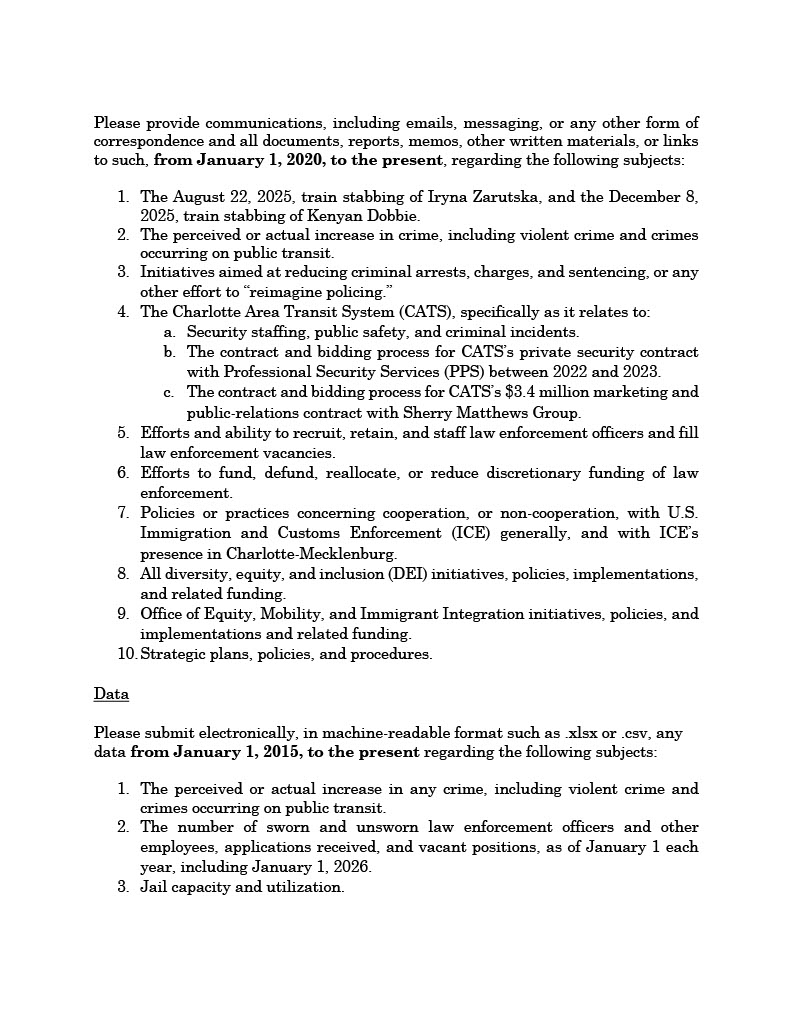
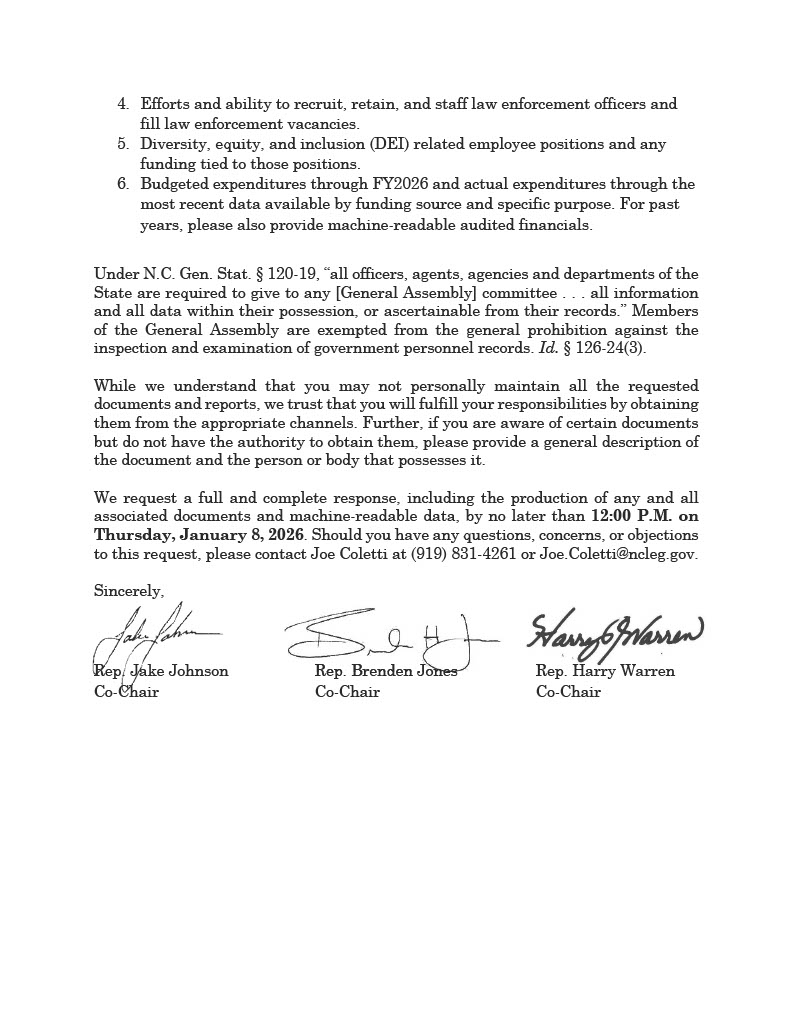
House Select Committee on Oversight and Reform Co-Chairs Jake Johnson (R-Polk), Harry Warren (R-Rowan), and Brenden Jones (R-Columbus) sent letters to officials from the City of Charlotte and Mecklenburg County requesting documents, communication, and data concerning crime and public safety.
The letters, sent to Charlotte Mayor Vi Lyles, Charlotte City Manager Marcus Jones, Charlotte-Mecklenburg Police Chief Estella Patterson, Mecklenburg County Sheriff Garry McFadden, Mecklenburg County Manager Mike Bryant, Mecklenburg County District Attorney Spencer Merriweather, and Charlotte Area Transit System Interim CEO Brent Cagle, can be found on the committee’s website.
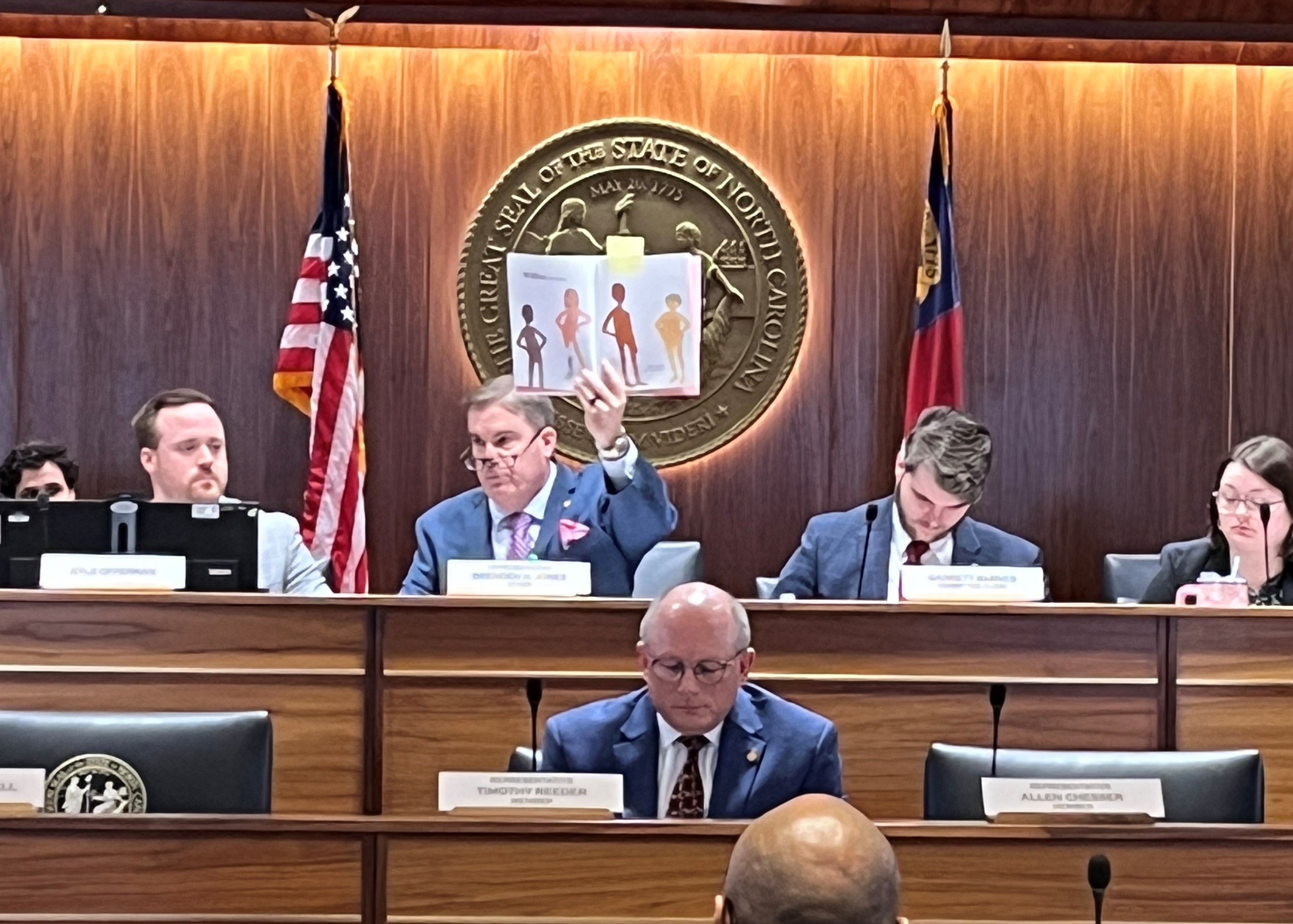
Rep. Brenden Jones (R-Columbus) and other members of the House Select Committee on Oversight and Reform pressed Chapel Hill-Carrboro City Schools (CHCCS) officials on the district’s defiance of state law, promoted resources, educational performance, enrollment, and finances during a contentious hearing on December 10.
Co-Chair Jones warned from the outset that the hearing would be uncomfortable. He told CHCCS Board Chair George Griffin and Superintendent Rodney Trice: “You are here today because you chose to wage war against the law. You chose to deceive the public, and now you are here because you got caught.”
The committee called Griffin and Trice to testify after a video in October showed Griffin bragging that CHCCS “was the only school district in North Carolina…that stood up to the General Assembly” on SB 49, The Parents’ Bill of Rights. The bill became law in August 2023 when the General Assembly overrode Gov. Roy Cooper’s veto. In January 2024, the school board voted unanimously to disregard two provisions of the law: a requirement to notify parents before changing their student’s name or gender, and a prohibition on sex and gender curriculum for children in grades kindergarten through fourth.
Despite repeated assurances to committee members that the district was complying with the law, Griffin eventually acknowledged that he thought the law conflicted with federal anti-discrimination law.
Jones held up three books on a list linked from the equity office’s resources page that could introduce young children to topics that should not be in the curriculum for young students under SB 49.
Trice said he was not familiar with the books or the link, but he said a rogue employee could not have posted the link without approval: “We have a multidisciplinary team that reviews materials or resources, particularly if those resources are going to be shared with parents.”
Chapel Hill-Carrboro Schools has a reputation as one of the best school districts in the state, and Trice said, “Certainly I would put the success of our students squarely to our parents. They’re very involved with the education and the direction of our school district. They demand high quality curricula, strong instructional approaches in the classroom. And beyond that, I would put our teachers up against any teachers in North Carolina or across the country for that matter.”
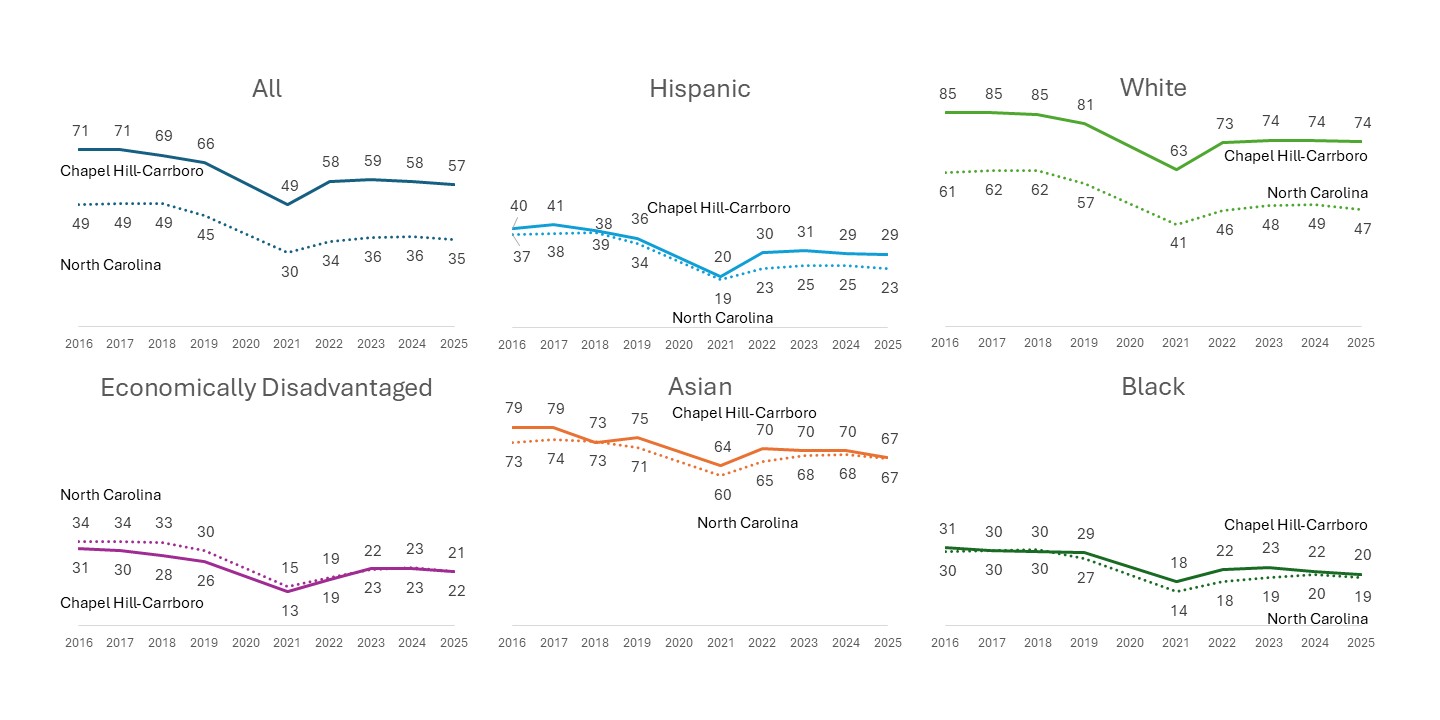
He was defensive of the district’s performance, but he did admit, “We struggled like many districts with closing opportunity gaps and achievement gaps in our district.” Committee staff analysis of state standardized testing found black, Hispanic, and economically disadvantaged students performed comparably to their peers in other school districts, and well below Asian and white students in CHCCS. White students were the only racial or ethnic group in CHCCS to outperform the state average for that group. [see graphs below]
“For the better part of a decade,” Trice said, “we’ve seen … declining enrollment,” which he called the district’s “biggest challenge” because enrollment is “one of the primary ways that school districts across North Carolina receive funding to educate their kids.” Rep. Charles Miller (R-Brunswick, New Hanover) was among those who questioned the district’s financial situation considering the district’s shrinking enrollment.
Rep. Mike Schietzelt (R-Wake) put the district’s enrollment and financial challenges in context with the legislature’s budget fight: “There’s a lot of mounting distrust with the public school districts as reflected by the declining enrollment right now.” Noting that the House budget included a significant raise for teachers, he added, “We care about the teachers because we care about the kids, and it makes it really difficult for us to do our job when the leaders of these school districts can’t come in here and even give us a straightforward answer to straightforward questions.”
“What you’re doing is wrong, and you lied to this committee under oath,” Jones emphasized. “You’ve replaced reading, math, and science with guilt, shame, and division. You’re teaching kids to feel guilty, either oppressed based on color of their skin, their family values, or what they believe. And while performing gaps grow wider and test scores fall off a cliff, you focused on one thing, spreading your ideology.”
“Let me be real clear,” he said in conclusion, “This General Assembly will use every tool, every statute, and every ounce of our authority to protect children and to force you to comply with the law. If you don’t follow it willingly, we will hold you to the fire with every legal and legislative mechanism in our power. You’ve made your choice, and we’ve made ours.”
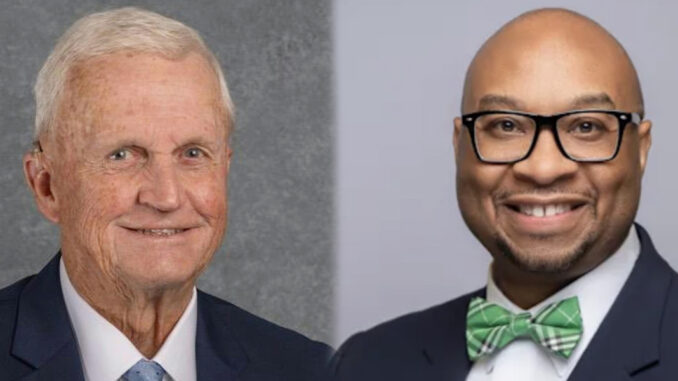
The House Select Committee on Oversight and Reform will hold a hearing December 10 at 9 a.m.
The committee will hear testimony from Chapel Hill-Carrboro City Schools (CHCCS) Board of Education Chair George Griffin and Superintendent Rodney Trice.
CHCCS came under scrutiny in October when a clip surfaced online of Griffin bragging that CHCCS was openly defying SB49, The Parents’ Bill of Rights. The bill became law in August 2023 when the General Assembly overrode Gov. Roy Cooper’s veto. The school board voted unanimously to refuse to develop policies that would notify parents when the school changed a student’s name or gender and keep gender identity, sexual activity, and sexuality out of the curriculum for children from kindergarten through fourth grade.
School board Chairman George Griffin in a video clip called it “ludicrous” to “wordsmith policies that legitimized discrimination.” Griffin added that CHCCS was “the only school district in North Carolina of 115 school districts that stood up to the General Assembly and said, ‘We’re not doing this.’”
Despite the strong language on video, Griffin’s written testimony states, “To my knowledge, Chapel Hill-Carrboro City Schools has always been, and continues to be, in compliance with the law-including the Parents Bill of Rights.” Superintendent Trice similarly states, “To my knowledge, the District has always complied with this law.” Other documents provided by the district, suggest some there may be some wordsmithing involved in reaching this conclusion.
Both written testimonies also tout the district’s academic performance and commitment to non-discrimination. Again, actions speak louder than words as black and Hispanic students perform near the same level as their peers across the state, reaching career and college ready status on end-of-year testing at less than half the rate of white students in the district.
“School systems funded by taxpayer dollars cannot run amok and make their own rules. Chapel-Hill Carrboro City Schools needs to focus on educating kids in science, reading, and math, rather than teaching them woke ideology.” Co-Chair Brenden Jones (R-Columbus) said.
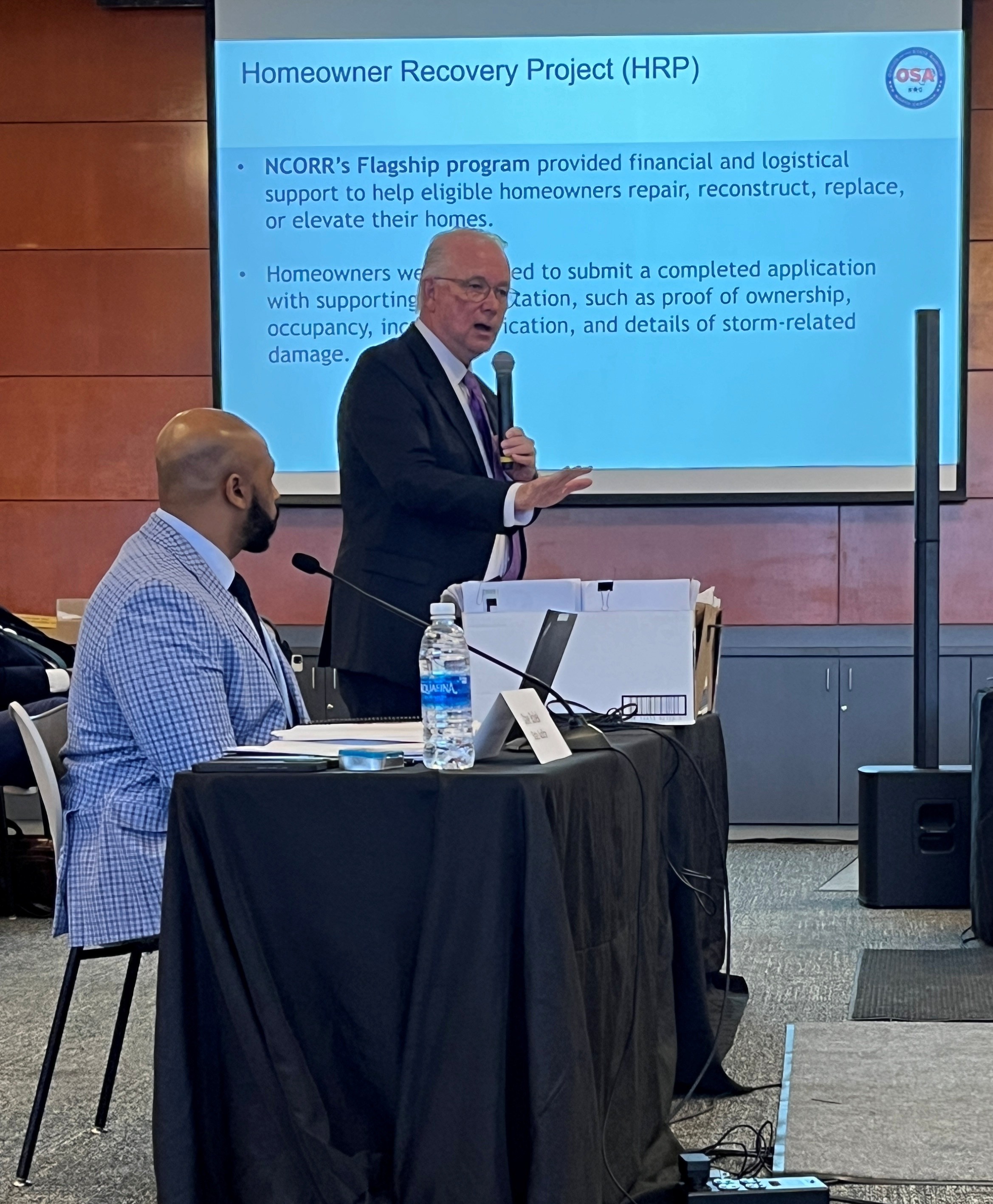
State Auditor Dave Boliek presented his report on the North Carolina Office of Recovery and Resiliency (NCORR) to the Joint Legislative Commission on Governmental Operations Subcommittee on Hurricane Response and Recovery on November 20. Hurricane Matthew in 2016 and Hurricane Florence in 2016, he said, “are two disasters, and quite frankly, the third disaster that this state has experienced is NCORR itself.”
Boliek detailed NCORR’s flaws to the subcommittee for two hours in a hearing at East Carolina University. Audit staff, according to Boliek, said NCORR had the worst accounting they had ever seen and that the program presented a logistical nightmare. He did, however, acknowledge that NCORR had fixed many of its procedural flaws beginning in 2022, particularly after Pryor Gibson stepped in last year. Coincidentally, legislative leadership formed the subcommittee in summer 2022.
NCORR Director Pryor Gibson said in his testimony, “There’s no question, there’s no excuses, there’s no sugarcoating the mess that was the first two or three years of NCORR.”
Created in 2018 to facilitate the repair and rebuilding of homes with federal Housing and Urban Development (HUD) funding, NCORR came under scrutiny from the General Assembly in 2022 when the program was completing fewer than 10 homes per month.
“Don’t take your foot off the gas.”
Rep. Karl Gillespie
As the subcommittee had heard in its five previous hearings: NCORR had problems managing its budget, data, and processes. NCORR received $982 million for disaster response and mitigation. The agency originally budgeted $534 million in grants for Matthew and Florence to the Homeowner Recovery Program (HRP). That amount eventually grew to $709 million before the General Assembly provided a $297 million bailout, bringing HRP alone to a sum greater than the federal money originally planned across all grant programs.
Subcommittee members questioned Boliek about the inconsistencies he documented across NCORR internal accounting, its reporting to the federal government through the Disaster Recovery Grant Reporting (DRGR) system, and the state’s consolidated accounting systems. One invoice had a 129% difference in the payment posted to each of the three systems.
Boliek and subcommittee members noted the marked improvement in outcomes once Gibson took over at NCORR. In turn, Gibson assured the subcommittee that all remaining projects would be underway before the end of the year and completed before October 2026.
Gibson shared that he has passed on the lessons he has learned from NCORR’s failures to the teams leading Hurricane Helene recovery efforts. Many of their processes so far correspond directly to the Auditor’s recommendations.
Co-chair Rep. Karl Gillespie (R-Macon) had one piece of advice for Gibson as NCORR works to get the final 328 families back home: “Don’t take your foot off the gas, and let’s get this thing done.”