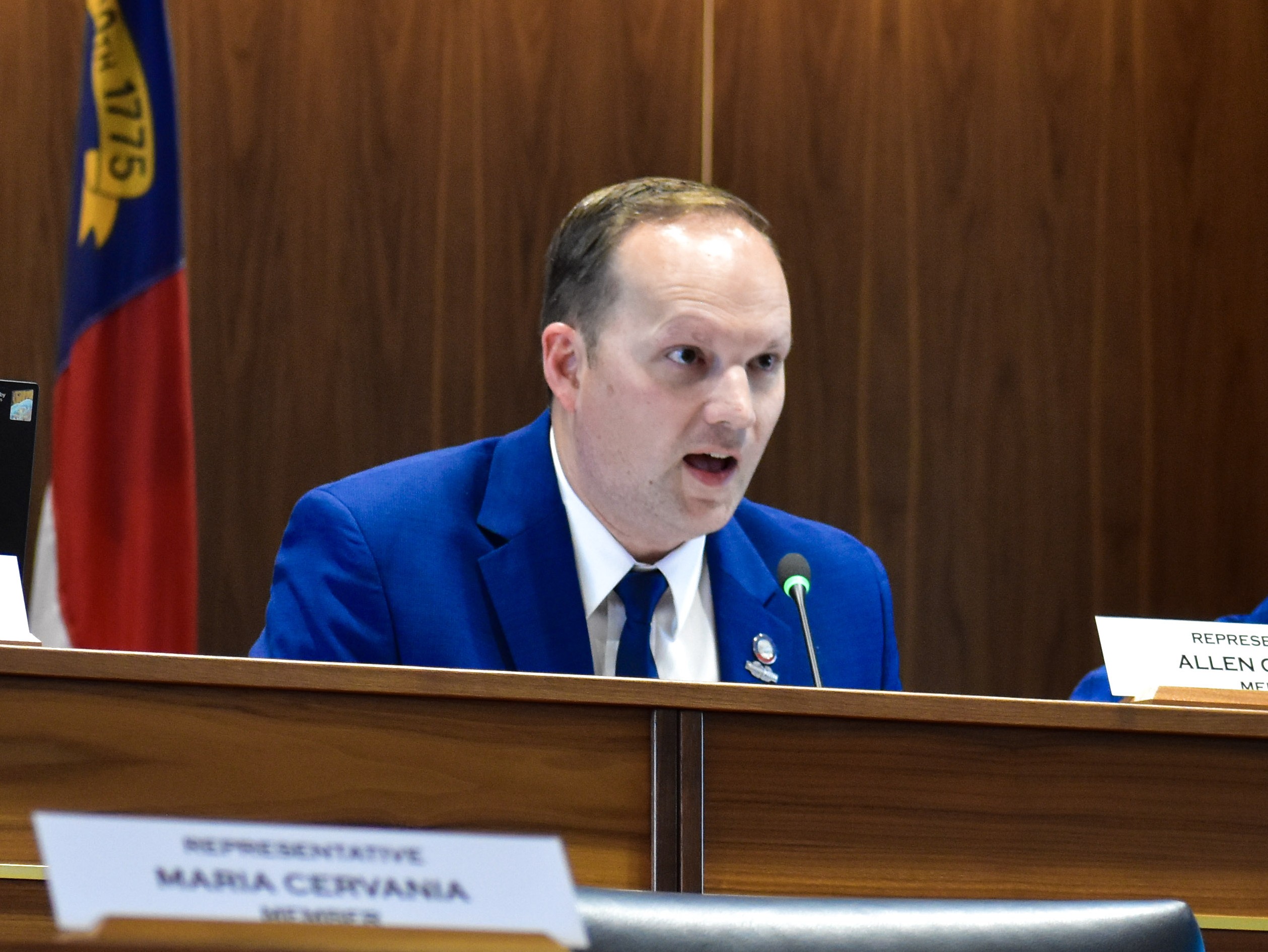
In a daylong hearing June 4 that provoked sadness and anger, House Oversight Committee members grilled Charlotte, Mecklenburg County, and state officials over the death of Dominique Moody—a six-year-old girl who had been tortured, abused, and kept in a dog cage until she died weighing just 27 pounds.
By the end of the day, Rep. Allen Chesser (R-Nash), who chaired the session, called for Mecklenburg County District Attorney to consider criminal charges against county employees for failing to intervene.
Members first questioned state Department of Human Services officials on their investigation of Mecklenburg County’s child protective services and discussed the potential value of predictive risk models with UNC School of Social Work professor Emily Putnam-Hornstein. Members then asked Charlotte Mecklenburg Police Chief Estella Patterson and Mecklenburg County Sheriff Garry McFadden about multiple law enforcement visits to the home over years.
County Manager Michael Bryant, Interim DSS Director Letecia Loadholt, and Deputy County Manager Kimm Campbell faced more than four hours of questions in the afternoon.
“Mecklenburg County received multiple reports of abuse and neglect and conducted assessments yet failed to intervene further,” NC Department of Health and Human Services Division Director for Human Services Lisa Tucker Cauley told the committee. She described multiple other failures across 122 additional cases NC DHHS examined.
Putnam-Hornstein said evaluations of predictive risk models had found they reduced both racial disparities and child fatalities. She was confident that “a model would have flagged her [Dominique’s] case for closer scrutiny.”
Putnam-Hornstein questioned Mecklenburg’s prioritizing new positions instead of better training and technology: “It’s not at all clear to me based on the facts that have been released that hiring 21 additional people in Mecklenburg County would have made any difference in Dominique’s case or is the kind of systemic change that is needed.”
In an early indication of his frustration with the county, Rep. Chesser asked Cauley, “What may exist in a home that would make it unsafe for a worker to go there but make it safe for a child to remain in that home?”
Members’ incredulity climbed with law enforcement’s testimony. Rep. Mike Schietzelt (R-Wake) wondered how clearly visible holes in floors and walls leading to the outside did not raise more concern: “There were flashing red signs that should have tipped people off that something was not right here.”
Rep. Carla Cunningham (D-Mecklenburg) emphasized that CMPD is not solely responsible but, “A lot of people closed their eyes and failed to see.”
Rep. Heather Rhyne (R-Lincoln) asked Bryant and Loadholt concentrated on the county’s tendency to downplay its problems. A Program Review found it performed “only slightly worse than other large metropolitan areas” on recurrence of maltreatment and other indicators.
“And I submit to you that, tragically,
Rep. Harry Warren
Dominique Moody was not served.”
Co-Chair Harry Warren (R-Rowan) told Bryant in relation to his role as county manager, “As you once said, and you’ll recall, I’m sure, we exist for one reason and for one reason only, to serve. And I submit to you that, tragically, Dominique Moody was not served. It wasn’t a lack of funding that led to her death, but it was poor performance, lack of supervision, and lack of a culture that was there to serve.”
Rep. Brian Echevarria (R-Cabarrus) read directly from an officer’s graphic account of the condition of the home and of the child. “It was extremely unkempt with strong odor of feces and urine. The residence was cluttered and numerous rats were scurrying through it. The residence had a mixture of animal and human feces throughout. … She had open wounds and scarring in various stages of healing covering most of her body.”
After calling for the district attorney’s to explore criminal charges, Rep. Chesser closed stating, “I hope that the plan you have in place, Mr. Bryant, with the trust that you’ve placed in these two ladies is well rewarded, but if it comes without consequences for those who cause the reason that you’re sitting here, it’s forfeit. It’s empty, it’s hollow, and it’s worth nothing.”
Video here.
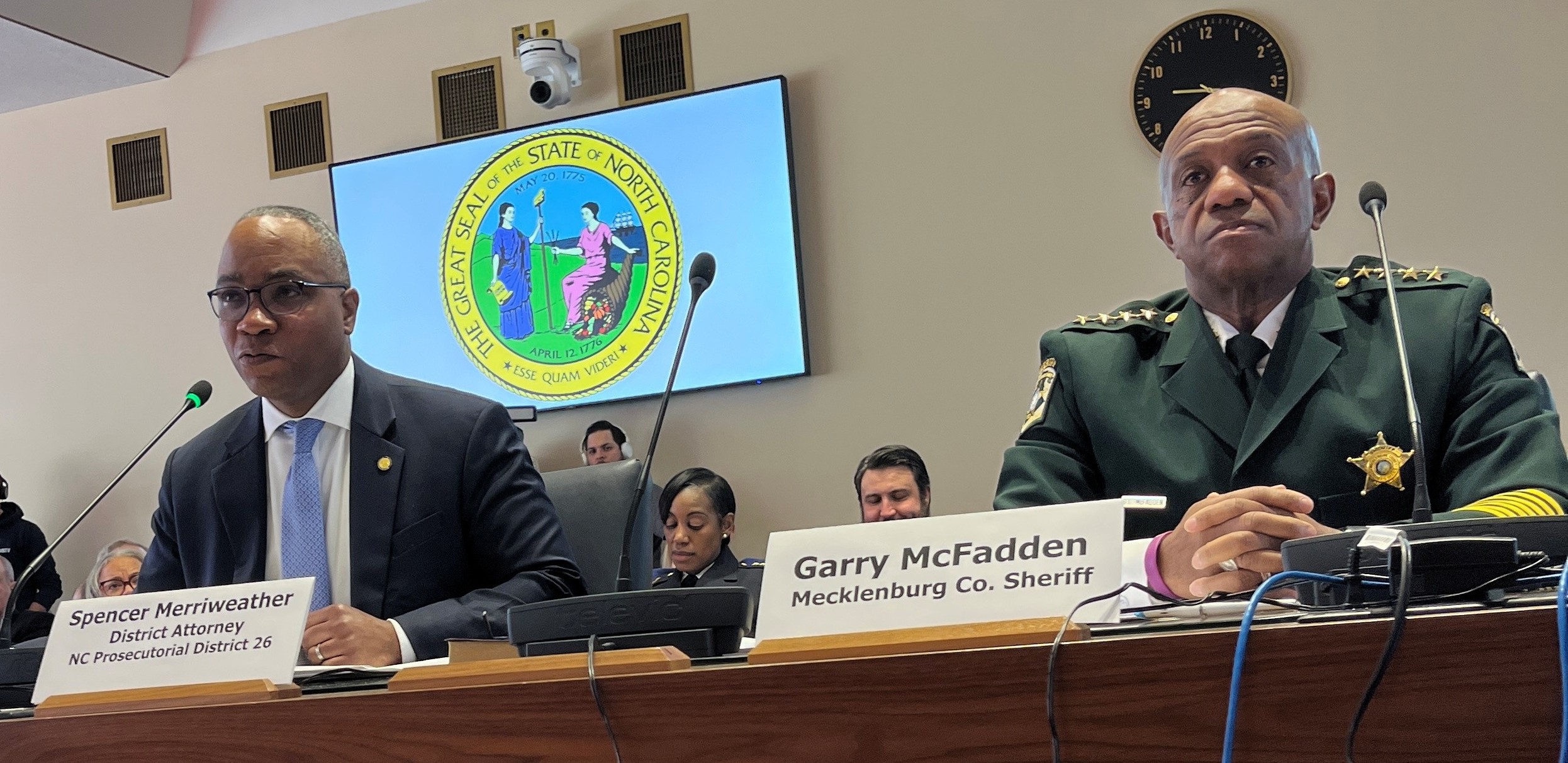
Mecklenburg County Sheriff Garry McFadden and other officials from Mecklenburg County and the City of Charlotte testified before the House Select Committee on Oversight and Reform on February 9. The planned topic was public safety, with concerns about immigration enforcement, mental health, public transit, and funding priorities
McFadden called himself the “elephant in the room” and lived up to that with long answers that bordered on lecturing committee members. The morning session with him and District Attorney Spencer Merriweather ran more than three hours, with most of that time dedicated to combative exchanges with the sheriff.
In contrast, the afternoon session with Charlotte-Mecklenburg Police Department Chief Estella Patterson, Mayor Vi Lyles, and City Manager Marcus Jones lasted just 80 combat-free minutes.
McFadden often said he could not answer questions due to ongoing litigation and an SBI investigation. Frustrated, Chairman Brenden Jones (R-Columbus) called a recess for McFadden to confer with his attorneys about what he could say.
Other than an impromptu civics lesson from Rep. Allen Chesser (R-Nash) that has gained national attention, members asked about safety in the county jail, work culture in the sheriff’s office, and detaining inmates for Immigration and Customs Enforcement (ICE).
McFadden said he still thinks Iryna’s Law is “a mistake” and that it has done “no good,” told the committee he was speaking specifically about Mecklenburg County. DA Merriweather called the legislation a “good thing.”
Asked why ICE picked up just 16% of Mecklenburg County inmates with a detainer in 2025 but picked up 65% of Wake County inmates, McFadden instead complained that state legislators did not seek his expertise before writing or passing the relevant laws.
Co-Chair Jake Johnson (R-Polk) explained to McFadden that being the only sheriff called to testify to the Committee “is not a point of pride.” Johnson added, “There are clearly problems within the department that we’re going to have to address going forward.”
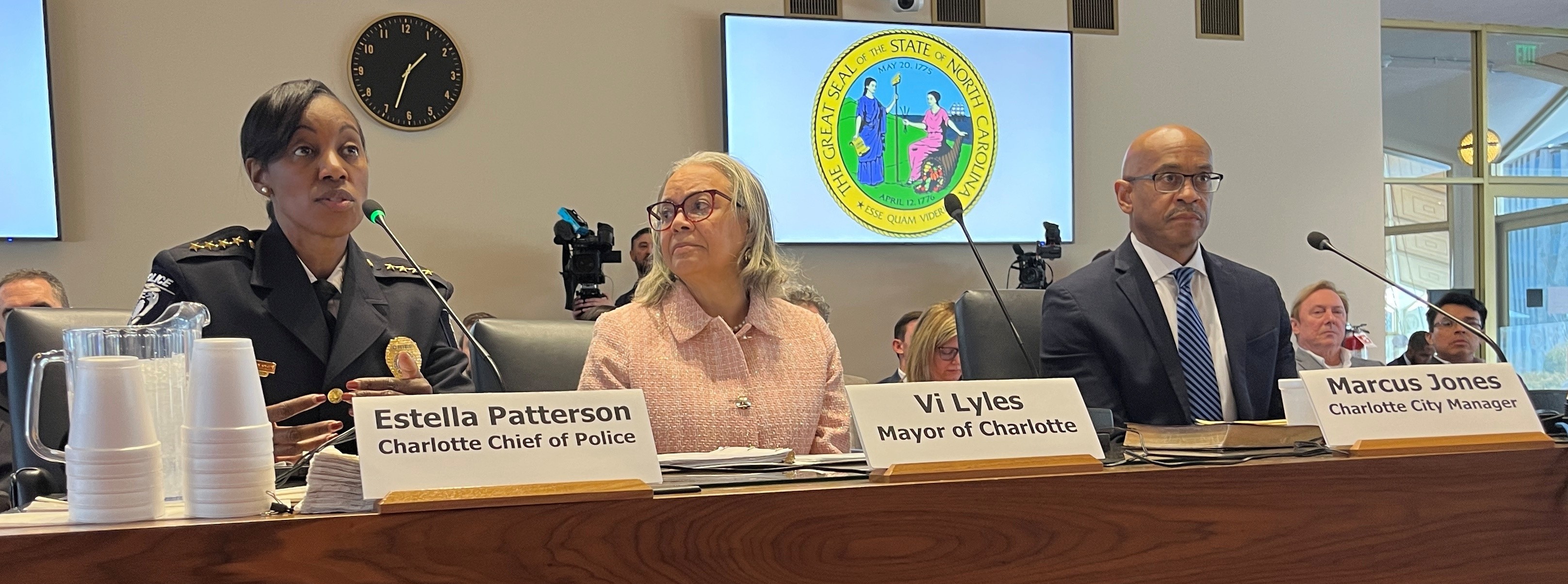
CMPD Chief Patterson described her plan to improve policing in Charlotte, including youth and mental health efforts. Rep. Brian Echevarria (R-Cabarrus) asked how the city could spend $100 million on diversity but not direct any of that to safety when 60% of violent crime victims are black.
Jones told Charlotte officials he wanted them to make national headlines for positive things, not for the not the things that have dominated the news cycle in recent months.
“I want Charlotte making national news for the World Military Games [next summer],” Rep. Jones concluded. “I want that city to be the shining gem of North Carolina that I know it can be.”
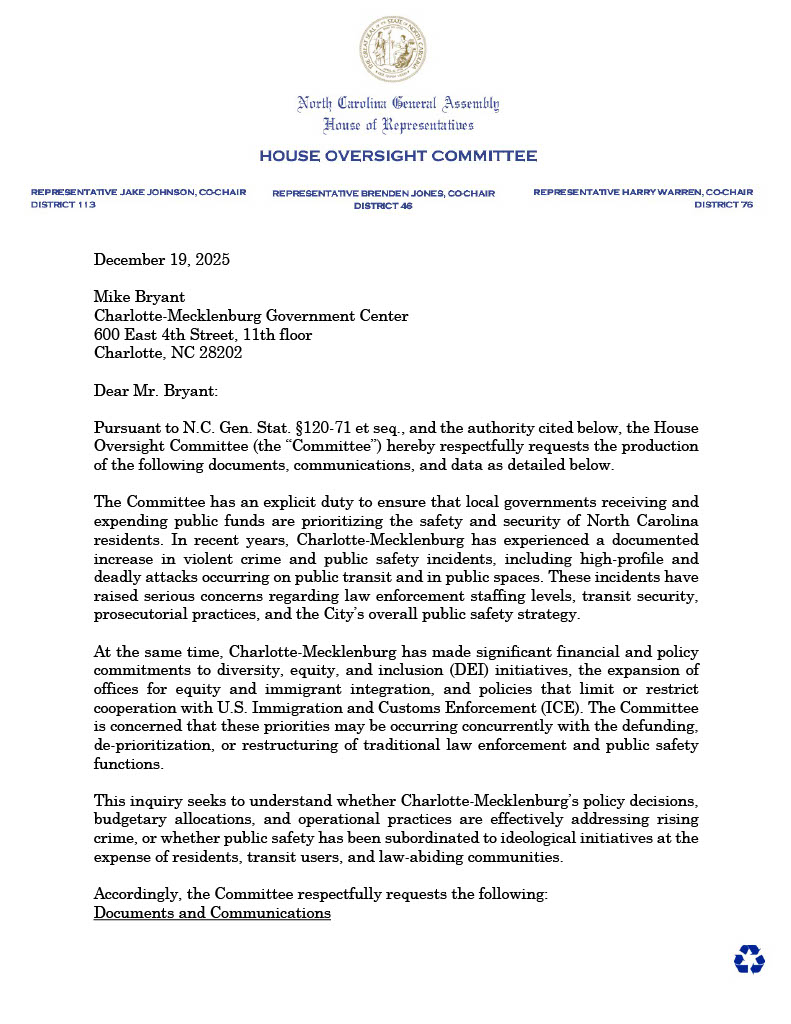
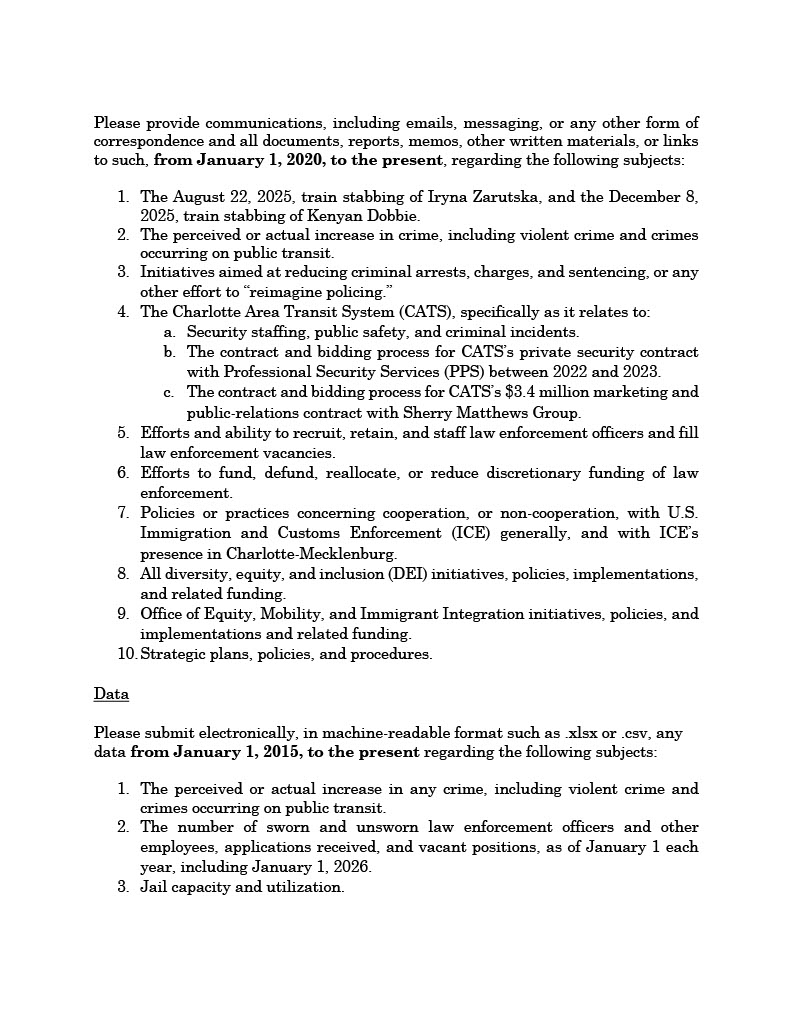
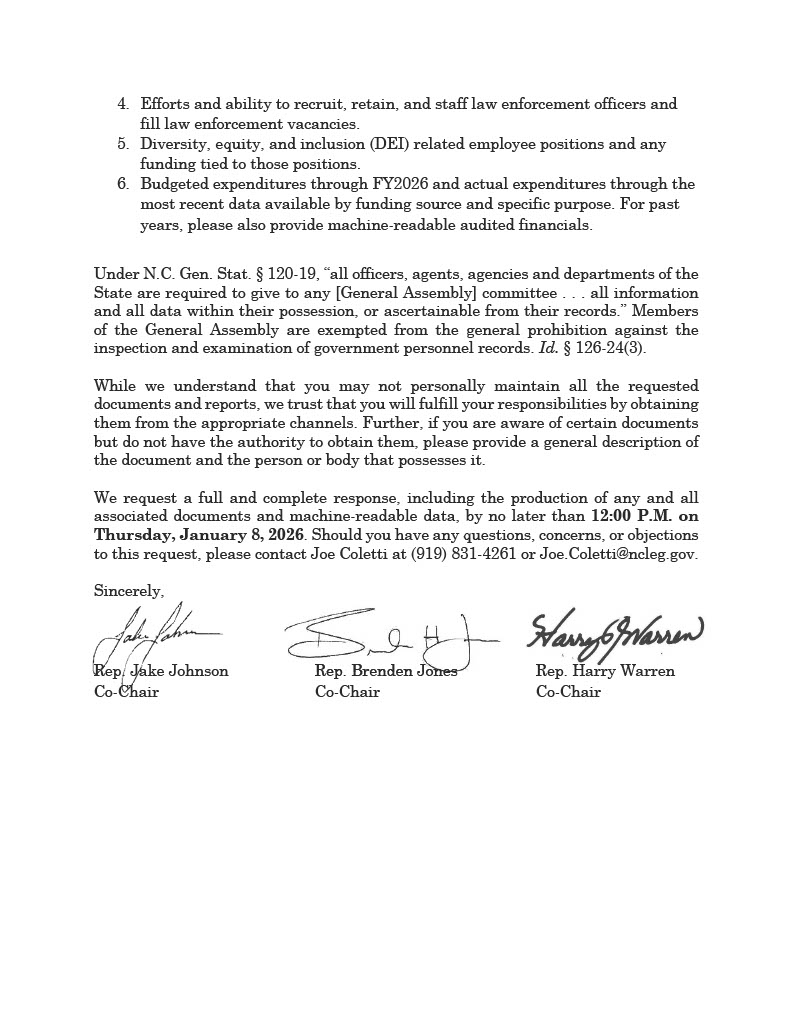
House Select Committee on Oversight and Reform Co-Chairs Jake Johnson (R-Polk), Harry Warren (R-Rowan), and Brenden Jones (R-Columbus) sent letters to officials from the City of Charlotte and Mecklenburg County requesting documents, communication, and data concerning crime and public safety.
The letters, sent to Charlotte Mayor Vi Lyles, Charlotte City Manager Marcus Jones, Charlotte-Mecklenburg Police Chief Estella Patterson, Mecklenburg County Sheriff Garry McFadden, Mecklenburg County Manager Mike Bryant, Mecklenburg County District Attorney Spencer Merriweather, and Charlotte Area Transit System Interim CEO Brent Cagle, can be found on the committee’s website.