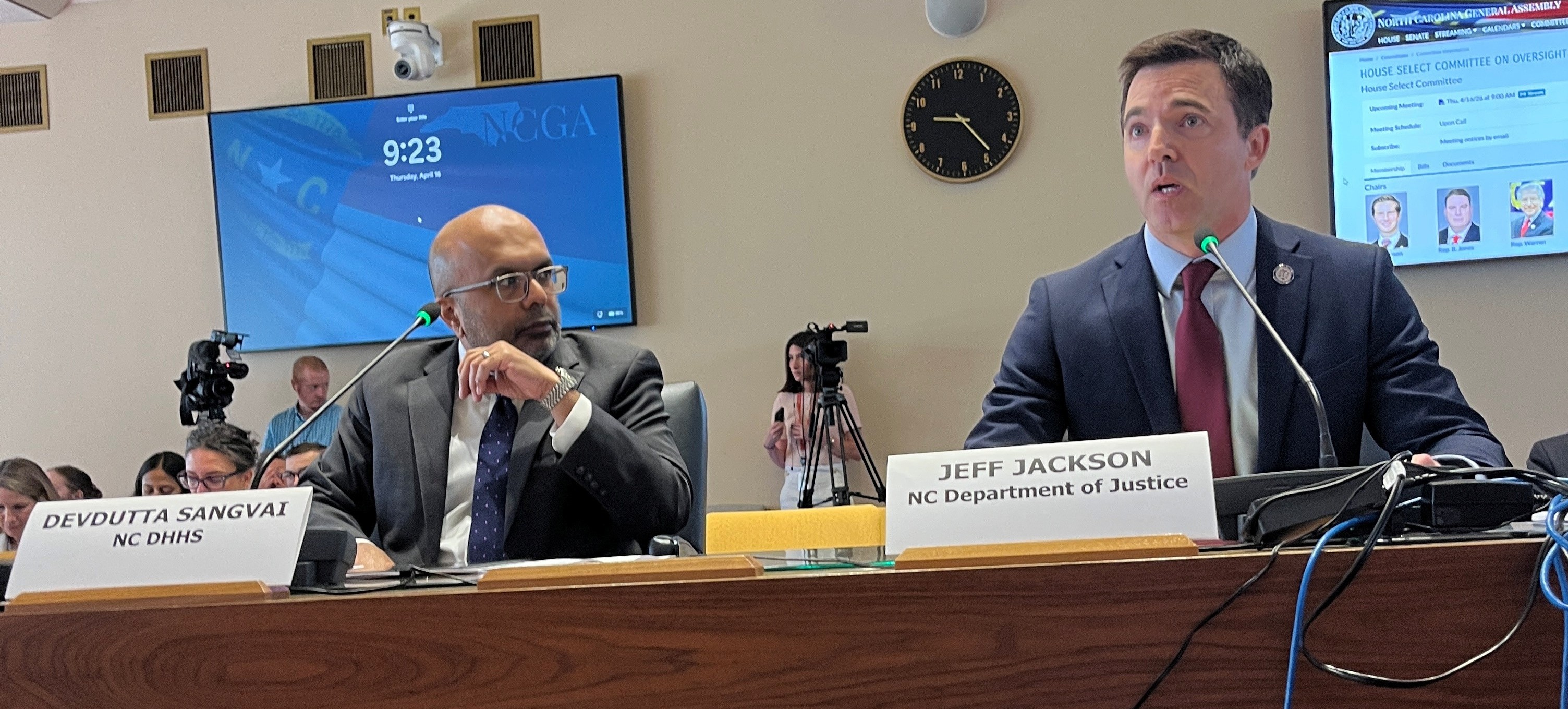
Chairman Grant Campbell (R-Cabarrus) opened the April 9 hearing of the House Select Committee on Oversight and Reform with a reminder of the program’s scale: it cost $36 billion in fiscal year 2025—more than the state’s General Fund— including $6 billion in state tax dollars. Medicaid enrollment grew by 984,000 people between 2019 and 2025, compared to total population growth of 710,000, and to cover 26 percent of the population.
Over the course of three hours, committee members asked Department of Health and Human Services Secretary Devdutta Sangvai and Attorney General Jeff Jackson what more their offices can do to detect, punish, and prevent waste, fraud, and abuse.
They asked about beneficiary and provider enrollment. Chairman Campbell highlighted one agency whose address is a building with boarded up windows according to Google. “Can we at least all agree that there’s much more that we can do to ensure this money is being used appropriately?” Campbell asked. Jackson and Sangvai said that North Carolina is actually ahead of other states in using data analytics to detect suspicious providers and charges.
Rep. Allen Chesser (R-Nash) asked why Medicaid referred just 114 of 1,867 complaints from insurers about providers to the DOJ’s Medical Investigations Division (MID). Rep. Mike Schietzelt (R-Wake) asked why North Carolina ranks 37th in the nation in criminal convictions for Medicaid fraud.
Jackson said the DOJ does not have authority to prosecute cases on its own and must hand them either to the appropriate local district attorneys or U.S. Attorney, noting that federal law provides stiffer criminal penalties for fraud than state law. Jackson added that the state can recover treble damages in civil cases but can only recoup payments in criminal cases.
Skyrocketing autism cases, partly driven by a change in what results in a diagnosis, led the General Assembly to increase reimbursement rates by 15 percent in 2023. These changes have brought flood of providers into the system. While necessary, all agreed, the changes increased the potential for fraud. Sangvai acknowledged that DHHS needed to tighten clinical policy as a way to reduce that potential.
Campbell emphasized that there are real consequences for the most vulnerable: “Every dollar of waste, fraud, or abuse that is unrecognized, unenforced, ignored is a dollar that’s not available for North Carolinians that need care.”
The hearing provided direction for Medicaid rebase bill HB696 and pointed to additional possible reforms in statute, policy, and practice.
Watch the hearing on YouTube.
View the transcript here.