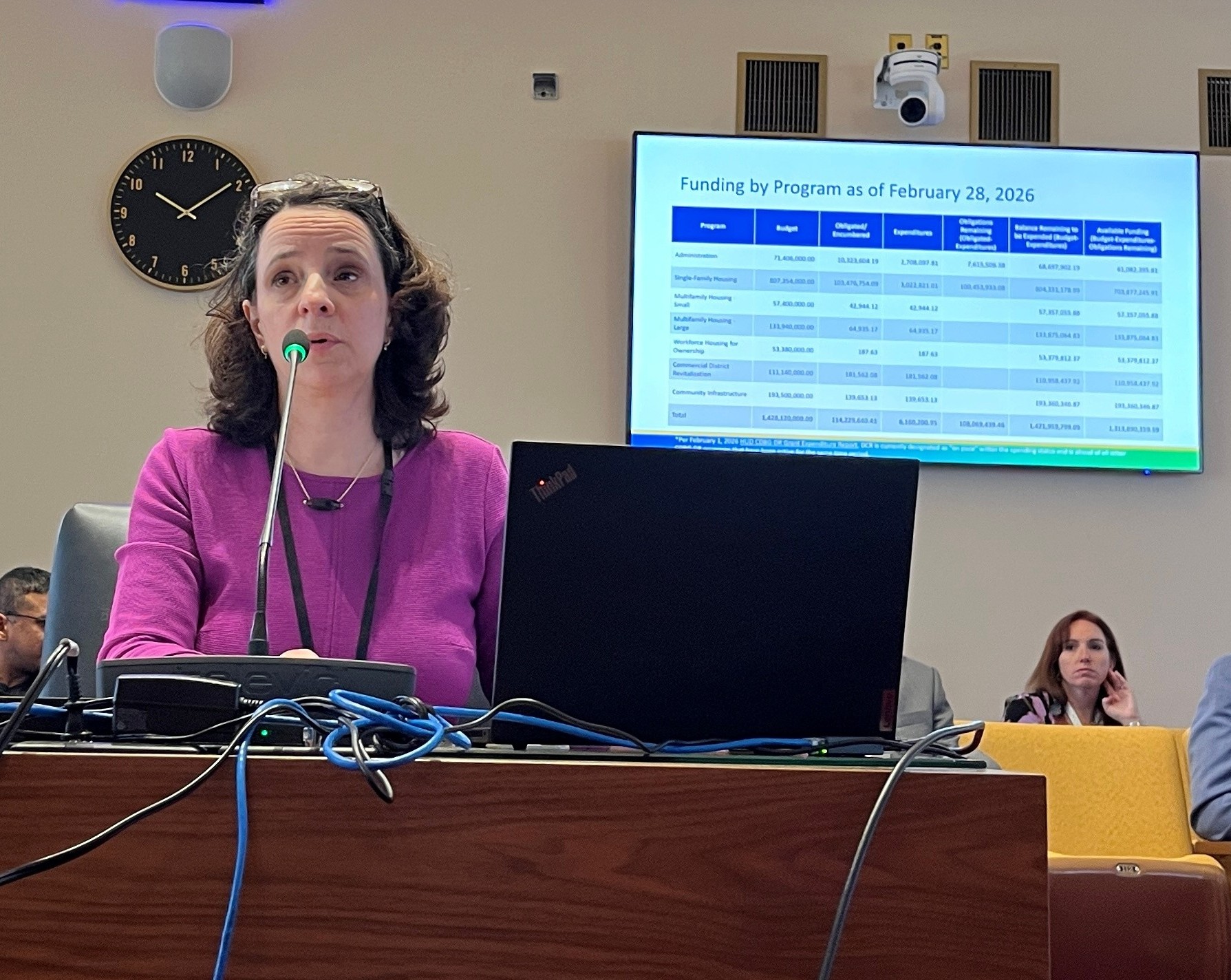
State officials touted progress on Hurricane Helene recovery at an April 2 legislative hearing — and at least one lawmaker wasn’t having it.
Testifying before the Joint Legislative Commission on Governmental Operations’ Hurricane Response and Recovery Subcommittee, Department of Commerce Deputy Secretary Stephanie McGarrah and GROW NC Director Matt Calabria updated members on the Renew NC homeowner repair program, state funding, and private road and bridge work.
Calabria and McGarrah highlighted that Renew NC has completed repairs on 30 homes — faster, they said, than any other state after any other storm. Rep. Karl Gillespie (R-Macon) called that claim an “insult” to the 3,704 homeowners still waiting.
“We need to be focusing on helping them, not on some small successes that we’ve had,” he said.
The math doesn’t work
As of April 2, the program has 3,597 active applications and $807 million in federal Community Development Block Grant-Disaster Recovery funding. McGarrah said the money would not cover everybody currently in the program at the current rate of $276,285 per home.
“The numbers don’t add up, and meanwhile, the citizens of North Carolina are suffering.”
Rep. Karl Gillespie
On the other hand, she also told members the program could build 800 homes per year and finish in three years, which would complete roughly 2,400 homes by the end of 2028. But mountain building seasons can run as short as six months, meaning contractors would need to complete 133 homes per month to hit that target. If it were able to complete all those homes for an average of $277,000, the program would finish under budget.
Gillespie wasn’t convinced of either the projected shortfall or the projected speed of completion. He flatly told McGarrah, “The numbers don’t add up, and meanwhile, the citizens of North Carolina are suffering.”
Relocation money, disputed priorities
McGarrah said severely limited rental availability will make the program difficult to use. She and Calabria proposed spending $60 million of $120 million, already appropriated by the General Assembly but unused, to pay temporary relocation assistance (TRA). McGarrah said the other $60 million funds could go toward affordable housing if not being poured back into the main single-family home program.
Rep. Mark Pless (R-Haywood) pushed back on the new construction idea: “What I care about is what got destroyed, and people are counting on us to build back because I gave them my word.”
McGarrah acknowledged the statutory language is vague on the ability to redirect the unspent $120 million and legislative action would likely be necessary to spend any of it.
Roads, bridges, and a $1 million question
Calabria reported that 74 private road and bridge projects have been completed, restoring access for 421 households, with 173 more underway.
Gillespie flagged high costs and long delays stemming from the way bridges have been planned, designed, and built: “We’ve had numerous conversations about private roads and bridges, and a $100,000 bridge costing $1 million — there’s room for improvement there.”
He closed the hearing with a promise of continued oversight.